Where Was Jesus Born?
Jesus’ birthplace and hometown
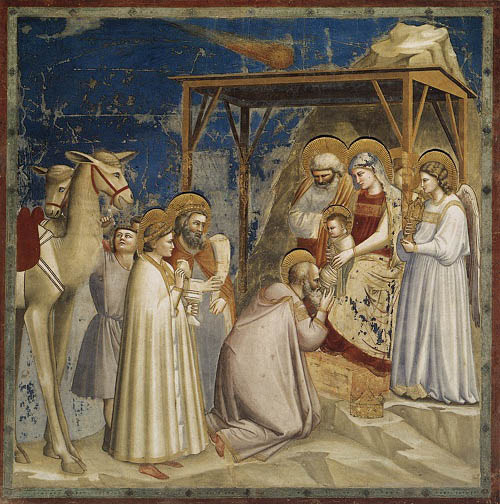
Where was Jesus born? In the Bible, Jesus’ birthplace is identified as Bethlehem. This scene from the Arena (Scrovegni) Chapel in Padua by the Italian artist Giotto shows Mary, Joseph and Jesus in the Bethlehem stable. The three wise men, along with their caravan, and angels gather around the child. Above the stable, Haley’s comet streaks across the sky. Haley’s comet was sighted in 1301, three years before Giotto painted this scene.
When the Christmas season draws near each year, the Nativity story is revisited in churches and households around the world. Passages from Matthew 1–2 and Luke 1–2, the infancy narratives in the Gospels, are read and sung—and even acted out in Christmas pageants.
Where was Jesus born? In the Bible, the answer seems straightforward: Bethlehem. Both Matthew 2 and Luke 2 state that Jesus was born in Bethlehem in Judea.
However, Biblical scholarship has called the identification of Bethlehem as Jesus’ birthplace into question: If Jesus was indeed born in Bethlehem, why is he called a Nazorean and a Galilean throughout the New Testament, and why is Bethlehem not mentioned as Jesus’ birthplace outside of the infancy narratives in the Gospels? This has caused some to wonder if Jesus was actually born in Nazareth.
In the November/December 2014 issue of BAR, Philip J. King addresses this question—where was Jesus born—in his Biblical Views column “Jesus’ Birthplace and Jesus’ Home.” He takes a close look at what the Bible says about the towns of Bethlehem, traditionally Jesus’ birthplace, and Nazareth, Jesus’ home.
FREE ebook: The First Christmas: The Story of Jesus’ Birth in History and Tradition. Download now.
While Bethlehem in Judea was known in the Hebrew Bible and New Testament as being the birthplace of King David and the birthplace of the future messiah, the small village of Nazareth in Galilee was much lesser-known, not even warranting a mention in the Hebrew Bible, the Talmud or in the writings of Josephus. King explains, “Nazareth derives its importance entirely from its relationship to the life and teaching of Jesus.”
The contrast between Bethlehem, the birthplace of King David, and Nazareth, a small agricultural village, is obvious. Yet both sites were significant in the life of Jesus.
So if Jesus was born in Bethlehem, as the Gospels of Matthew and Luke attest, why was he called a Nazorean? To see what Philip J. King thinks—and for more information about the Biblical towns of Bethlehem and Nazareth—read the full column “Jesus’ Birthplace and Jesus’ Home” in the November/December 2014 issue of BAR.
BAS Library Subscribers: Read the full column “Jesus’ Birthplace and Jesus’ Home,” by Philip J. King in the November/December 2014 issue of Biblical Archaeology Review.
Not a BAS Library or All-Access Member yet? Join today.
Related reading in Bible History Daily
All-Access members, read more in the BAS Library
The Infancy Narratives in Matthew and Luke—Of History, Theology and Literature
Not a BAS Library or All-Access Member yet? Join today.
This Bible History Daily feature was originally published on November 17, 2014.
Related Posts


Must-Read Free eBooks
Want more Bible history?
Sign up to receive our email newsletter and never miss an update.
Unlock Unlimited Access to the Bible's Past

Unlock Unlimited Access to the Bible's Past
Become an All-Access Member to explore the Bible's rich history. Get Biblical Archaeology Review in print, full online access, and FREE online talks. Plus, enjoy special Travel/Study discounts. Don't miss out—begin your journey today!

The author of the article takes John 7:42 completely out of context. It is an argument AGAINST Jesus having been born in Bethlehem. I doubt it was an accidental oversight.
You lost me at: “Biblical scholarship.” Who? What scholarship? What are their degrees? Where did they study? Maybe this “Biblical scholarship” only incudes the author? Supposed biblical scholars who don’t believe in the Bible? Lots of those in BAR. People who call themselves scholars, but their sole intention is to destroy the Bible as truth? Lots of the those in BAR too!
This is another heretical teaching of Biblical Archeology. And you want to know why I don’t accept your offer of receiving the magazine. Now to the important matter at hand, WHERE WAS JESUS BORN? Let me start by saying my brother was born in Champaign-Urbana, IL in 1984 although in 1986 we moved back to Louisville, KY, so when the Bible says Jesus was born in Bethlehem I don’t question it. Now to the other question you raised, WHY WAS JESUS CALLED A NAZARENE? Well again if Biblical Archeology would search for the truth instead of taking people’s word for it, Scripture teaches that after Joseph and Mary returned from Egypt they settled in Nazareth and was where Jesus grew up (Matthew 2:19-23, Luke 2:4 & verse 39). So the implication for me is and a lot of other Christians is that because when Scripture says this was to fulfill prophecy (Matthew 2:23 cross reference the Old Testament references of Ps. 22:6, 13; 69:10, Isaiah 49:7 & 53:3 and Micah 5:1) we see this was to fulfill prophecy. PLEASE GET YOUR FACTS STRAIGHT BEFORE PUBLISHING THINGS LIKE THIS.
you don’t know what you’re talking about.
Justin, in his Apology, 1.34, says: “And thou, Bethlehem, the land of Judah” etc. ‘Now there is a village in the land of the Jews, 35 stadia [4.1 miles] from Jerusalem, in which Jesus Christ was born, as you can [still] ascertain also from the registers of the taxing made under Cyrenius, your first procurator in Judea.”
In my opinion the idea of Bethlehem as the birthplace was a christian invention in order to associate Jesus with the line of David. The gospel stories describing why his parents went to Bethlehem (for the purpose of a census) are implausible. Most likely Jesus was born in Nazareth.
E.P. Sanders in his book “The historical Figure of Jesus” gives a very good analysis on this subject. In fact the birth narratives of Matthew and Luke must be discarded as historical sources.
The idea that everyone should be required to return to the hometown of their ancestors for a census is preposterous. The entire population of the region would have been uprooted by such a decree. It would have resulted in chaos.