Where Was Jesus Born?
Jesus’ birthplace and hometown
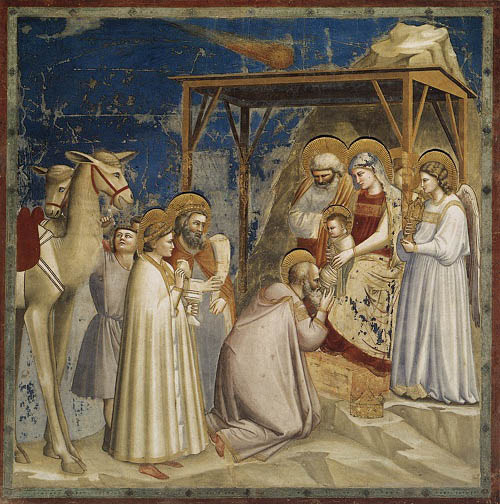
Where was Jesus born? In the Bible, Jesus’ birthplace is identified as Bethlehem. This scene from the Arena (Scrovegni) Chapel in Padua by the Italian artist Giotto shows Mary, Joseph and Jesus in the Bethlehem stable. The three wise men, along with their caravan, and angels gather around the child. Above the stable, Haley’s comet streaks across the sky. Haley’s comet was sighted in 1301, three years before Giotto painted this scene.
When the Christmas season draws near each year, the Nativity story is revisited in churches and households around the world. Passages from Matthew 1–2 and Luke 1–2, the infancy narratives in the Gospels, are read and sung—and even acted out in Christmas pageants.
Where was Jesus born? In the Bible, the answer seems straightforward: Bethlehem. Both Matthew 2 and Luke 2 state that Jesus was born in Bethlehem in Judea.
However, Biblical scholarship has called the identification of Bethlehem as Jesus’ birthplace into question: If Jesus was indeed born in Bethlehem, why is he called a Nazorean and a Galilean throughout the New Testament, and why is Bethlehem not mentioned as Jesus’ birthplace outside of the infancy narratives in the Gospels? This has caused some to wonder if Jesus was actually born in Nazareth.
In the November/December 2014 issue of BAR, Philip J. King addresses this question—where was Jesus born—in his Biblical Views column “Jesus’ Birthplace and Jesus’ Home.” He takes a close look at what the Bible says about the towns of Bethlehem, traditionally Jesus’ birthplace, and Nazareth, Jesus’ home.
FREE ebook: The First Christmas: The Story of Jesus’ Birth in History and Tradition. Download now.
While Bethlehem in Judea was known in the Hebrew Bible and New Testament as being the birthplace of King David and the birthplace of the future messiah, the small village of Nazareth in Galilee was much lesser-known, not even warranting a mention in the Hebrew Bible, the Talmud or in the writings of Josephus. King explains, “Nazareth derives its importance entirely from its relationship to the life and teaching of Jesus.”
The contrast between Bethlehem, the birthplace of King David, and Nazareth, a small agricultural village, is obvious. Yet both sites were significant in the life of Jesus.
So if Jesus was born in Bethlehem, as the Gospels of Matthew and Luke attest, why was he called a Nazorean? To see what Philip J. King thinks—and for more information about the Biblical towns of Bethlehem and Nazareth—read the full column “Jesus’ Birthplace and Jesus’ Home” in the November/December 2014 issue of BAR.
BAS Library Subscribers: Read the full column “Jesus’ Birthplace and Jesus’ Home,” by Philip J. King in the November/December 2014 issue of Biblical Archaeology Review.
Not a BAS Library or All-Access Member yet? Join today.
Related reading in Bible History Daily
All-Access members, read more in the BAS Library
The Infancy Narratives in Matthew and Luke—Of History, Theology and Literature
Not a BAS Library or All-Access Member yet? Join today.
This Bible History Daily feature was originally published on November 17, 2014.
Related Posts


Must-Read Free eBooks
Want more Bible history?
Sign up to receive our email newsletter and never miss an update.
Unlock Unlimited Access to the Bible's Past

Unlock Unlimited Access to the Bible's Past
Become an All-Access Member to explore the Bible's rich history. Get Biblical Archaeology Review in print, full online access, and FREE online talks. Plus, enjoy special Travel/Study discounts. Don't miss out—begin your journey today!

As to the fleeing from Bethlehem and subsequent journey into Egypt because King Herod had ordered the killing of all male infants born in Bethlehem, there is absolutely no references of this in any Histories written of his reign by any author from that period or later, Judean or otherwise.
All other atrocities that were ordered by, and occurred during the reign of Herod the Great were recorded in the Histories of his reign. This alone should make you ask why was the slaughtering of the male infants of Bethlehem never mentioned or recorded. The answer is, because it never occurred during the time of King Herod’s reign.
“If Jesus was indeed born in Bethlehem, why is he called a Nazorean…?” Puzzling indeed. I’m glad “biblical scholarship” is devoting time to finding an answer to this pressing mystery. Oh wait, here it is! “21 And he [Joseph] rose and took the child and his mother and went to the land of Israel. 22 But when he heard that Archelaus was reigning over Judea in place of his father Herod, he was afraid to go there, and being warned in a dream he withdrew to the district of Galilee. 23 And he went and lived in a city called Nazareth, so that what was spoken by the prophets might be fulfilled, that he would be called a Nazarene.” Matthew 2:21-23. So he was called a Nazorean because his father “took the child and his mother” and went to live there. Mystery solved!
It’s interesting that Nicholas mentioned the year 6 B.C.E. as the year of Jesus’ birth, that’s in sync with someone’s dating of a census imposed on the population by the Romans under the procurator Coponious:
:”Under his [Coponious’] administration, a Galilean, named Judas, incited his countrymen to revolt, upbraiding them as cowards for consenting to pay tribute to the Romans and tolerating mortal masters, after having God for their Lord. This man was a sophist [that is, a teacher] who founded a sect [that is, a school of thought] of his own, having nothing in common with the others. Jewish philosophy, in fact, takes three forms. The followers of the first school are called Pharisees, of the second Sadducees, of the third Essenes. (Josephus, Jewish War 2.117-118)” (“The Historical Jesus” by John Dominic Crossan, p. 112).
This was the same Judas the Galilean mentioned in Acts 5:37, whose revolt was put down by the Romans and so here is the backdrop of violence at the time of Jesus’ birth that is attributed to Herod nearly a century later in the gospel of Matthew. Notice how the reference to Rachel is made in connection with Bethlehem in Matthew 2:16-18 that is based on Jeremiah 31:15 and that Rachel is the matriarch who died while giving birth on the way to Ephrath that was Bethlehem (Genesis 35:19). In the non-canonical “Protoevangelium of James,” Mary gives birth to Jesus in a cave near Bethlehem, being alone while Joseph searched for a midwife. The dark cave is symbolic of Rachel naming her son Ben-oni (son of my sorrow, trouble or vigor) and according to the book of Zohar (1:175a), “she named him Ben Oni, for the harshness of judgement decreed against her” (“The Zohar” by Daniel Matt, vol. 3, p.58). The naming of the child by his father as Ben Yamin (son of the right hand, or son of the south) was interpreted by the Jewish mystics to mean the attribute of loving-kindness since the right hand symbolizes mercy while the left hand symbolizes the attribute of judgement. To mitigate the severity of judgement a third attribute combines judgement with mercy and this is known as “rahamin” or compassion. This term is also used in the Koran as “Al Rahamu” or “(God) Most Gracious,” and in the Muslim version of the Jesus birth narrative, Mary gave birth beneath a palm tree under which was a rivulet flowing (Koran 19:23-25) and the source for this tradition is likely Christian since there was a structure known as a martryrium that was later converted to a mosque at the site where Mary was believed to have rested on the way to Bethlehem:
“In about 456, according to Cyril of Scythopolis, a church was built to mark the spot where Mary dismounted and sat down outside of Bethlehem. It is called the Kathisma, ‘seat’ or ‘chair’ in Greek” (“Where Mary Rested” by Hershel Shanks, BAR, Nov./Dec. 2006, p. 46).
If I remember correctly, a book called “Ra’aya Meheimnu” (The Faithful Shepherd), that like the book of Zohar, appeared in the late 13th century. It made a connection between Rachel giving birth near Ephrath and the attribute of “rahamin” by linking it to the word for womb, “rachem.” I believe this is significant in that there is an inter-faith connection that relates to the location of Ramat Rachel where there was a a royal Judahite palace in the late 8th century B.C.E. that had pillars flanking the entrances upon which proto-Aeolic capitals resembled palmettes, that is, palm fronds which have not yet opened. Perhaps this is symbolic of worldly government being in a potential state: “Faith is the assured expectation of things hoped for, the evident demonstration of realities though not beheld” (Hebrews 11:1).
Some websites provide some more tantalizing evidence;
[Broken URL removed by site admin]
http://www.doxa.ws/Jesus_pages/Nazareth1.html
To me it does not matter where Jesus was born, only that he was and died for our sins.
It has nothing to do with a town called Nazareth.
Jesus was called the Nazarene, in Math 2:23, because he was of the Nazarene sect. Saul was also identified as a Nazarene, in Acts 24:5. And if Saul was an aspiring apostle, then you can be sure he was a (lowly) member of the same sect as Jesus.
And do remember that Queen helena of Adiabene was also a Nazarene, according to the Talmud. And it was Helena who saved Jerusalem from famine, and furnished the Temple of Jerusalem. These Nazarenes were very wealthy, and closely linked to the Judaean establishment. See the book ‘King Jesus’.
R
Psalms 119:165 Great peace have they which love thy law: and nothing shall offend them. I agree with tfm above, we walk by faith and not by sight. We know that in the end, many will be deceived by lying signs and wonders. I know in my heart and mind that Jesus is the Son of God, that He lived, died and was resurrected and now ministers in the heavens as my high priest. Study is good…but be sure what you are studying is God’s revealed knowledge and not that of man.
The birth narrative in Matthew is a cosmic myth and cannot be taken seriously. It centers around Orion, Cancer, Virgo and Sirius (Star of the East). It wanted to show Jesus was born during the reign of Herod among other things. Luke is a more convincing tale, having Jesus born in 7 AD. It uses a vision to connect to Herod instead. Probably both narratives are false. If Jesus was historical, most likely he was born in Jerusalem. In order to deify him, his birth narrative had to connect him to a birth in Cancer with Virgo as his mother. This was common of that age for most great men. Virgo is also the sign for bread or “house of bread” which would place his earthly birth in Bethlehem.
Bethlehem in Hebrew means “Bakery”. There where many towns in ancient Israel given this title: Bethlehem of Judea, Bethlehem of Samaria and Bethlehem of Galilee…just a few of miles from Nazareth. This is probably the Bethlehem where Jesus was born.
Nazareth is where Jesus was brought up, raised as a child. Therefore, where he was raised, not born, why he is called a Nazarene.