Where Noah Landed
From Strata in the November/December 2014 issue of BAR
Still another group is looking for Mt. Ararat, where the Bible says Noah landed after the flood. This group is looking to confirm the tradition that nearby Mt. Cudi (Judi Dagh) is really Mt. Ararat, as recorded in the Quran, Sura 11.44.
They have not uncovered much scientific evidence to date, but they do have an intriguing Assyrian relief, which may explain why a local tradition regards Mt. Cudi as Mt. Ararat.
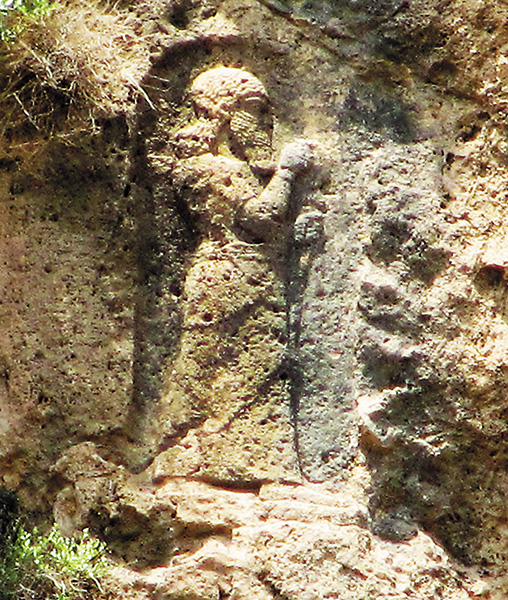
Assyrian relief on the slopes of Mt. Cudi near the Turkish village of Sah. Photo: Courtesy Professor Ibrahim Baz of the University of Sirnak, Turkey.
This photo was taken some months ago on the slopes of Mt. Cudi near the Turkish village of Sah. The figure, who has not yet been identified, dates to a period earlier than Sennacherib (who ruled 705–681 B.C.); there is no accompanying inscription. He has his right hand raised in a gesture of reverence and holds a staff of office in his left hand.
Alan Millard, Emeritus Rankin Professor of Hebrew and Ancient Semitic Languages at the University of Liverpool, offers a possible identification for the figure: Shamshi-ilu. Millard explains that since the figure is not wearing any headdress, as might be expected of an Assyrian king, it is more likely that he represents a powerful prefect, such as Shamshi-ilu, who held sway over much of Northern Syria from c. 780 to 745 B.C. Shamshi-ilu left inscriptions in his own name at Til Barsip (modern Tell Akhmar) on the Euphrates, in which he tells of his victorious campaign against places in southeastern Turkey and the kingdom of Urartu, which would have taken him into the vicinity of Judi Dagh.
Become a BAS All-Access Member Now!
Read Biblical Archaeology Review online, explore 50 years of BAR, watch videos, attend talks, and more

Reliefs of Sennacherib were also found on Mt. Cudi and documented by L.W. King, an English archaeologist who taught Assyriology at King’s College in Cambridge and later worked at the British Museum.
Is there any connection between Mt. Cudi and the Genesis flood account—a complex narrative in the Hebrew Bible?1
Genesis 8:4 says that after the flood waters subsided, “the ark came to rest on the mountains of Ararat.” While the Biblical text says “mountains” (plural), therefore referencing a range rather than an individual mountain, many have tried to identify the specific mountain on which Noah’s ark came to rest.

FREE ebook: Exploring Genesis: The Bible’s Ancient Traditions in Context Mesopotamian creation myths, Joseph’s relationship with Egyptian temple practices and 3 tales of Ur, the birthplace of Abraham.
In his book The Ark before Noah: Decoding the Story of the Flood, Irving Finkel of the British Museum discusses three mountains that have flood stories affiliated with them. The first (and most famous) bears the name Mt. Ararat (Agri Dagh). The highest peak in its region, Mt. Ararat is a dormant volcano located in eastern Turkey near the border with Iran and Armenia. The second is Mt. Cudi, and the third is Mt. Nisir (Pir Omar Gudrun), where the ark rested according to the Gilgamesh Epic.

A map of the three “Ark Mountains.” Photo: From Irving Finkel, The Ark before Noah: Decoding the Story of the Flood (New York: Nan A. Talese/Doubleday, 2014).
Many expeditions have been launched to hunt for Noah’s ark over the years. While the ark itself remains elusive, we can only hope that more finds like this interesting Assyrian relief continue to surface.
“Strata: Where Noah Landed?” originally appeared in the November/December 2014 issue of Biblical Archaeology Review.
Notes
1. See Ronald S. Hendel, “Noah, Enoch and the Flood: The Bible Meets Hollywood,” BAR, July/August 2014, and Ronald S. Hendel, “The Search for Noah’s Flood,” Bible Review, June 2003.
Related reading in Bible History Daily
The Animals Went in Two by Two, According to Babylonian Ark Tablet
All-Access members, read more in the BAS Library
Not a BAS Library or All-Access Member yet? Join today.
This Bible History Daily feature was originally published on November 26, 2014.
Related Posts


Must-Read Free eBooks


Want more Bible history?
Sign up to receive our email newsletter and never miss an update.
Unlock Unlimited Access to the Bible's Past

Unlock Unlimited Access to the Bible's Past
Become an All-Access Member to explore the Bible's rich history. Get Biblical Archaeology Review in print, full online access, and FREE online talks. Plus, enjoy special Travel/Study discounts. Don't miss out—begin your journey today!

The story of Noah’s ark in Genesis was a fable that the biblical priests used to insert a numerical puzzle that related to the heavens. The puzzle is in the dating system and it began where it stated the flood started on the 17th day of the second month and it rained for forty days and forty nights and the waters rose for 150 days. The ark then rested on Mount Ararat on the 17th day of the seventh month. A biblical month was thirty days long and therefore it was 150 day from when the flood started to the 17th day of the seventh month but the waters did not have time to recede so how could the ark rest on Mount Ararat?
The answer to the puzzle is to date events back in time and the timing works out where there is time for the waters to recede. The priests employed a formula withe the puzzle and I have worked out that formula and it relates to measuring time with respect to what is called star or sidereal time. Would anyone like to hear more about this formula and why the priests used it to convey a message with travelling back in time? t
@Michael, I surely do.
Nehemie, Can you send me your E mail address to [email protected] and I will send you the project paper on the findings. It is around 20 pages long and so too large to post here on this blog. Michael
Yes Mike, send me the formula, plus your research. THANKS
I’ll add a clue. When Noah (by any other name) sent out the Dove it came back with a twig in its beak. Noah spent further time in the Ark. It would not be at the top of any Mountain. The water receded between the return of the twig and the exit from the Ark. Happy hunting.
Walter,
I need your E mail address to send you a copy of the E book, which I published on the topic.
sir yes i m agree
vishvas
sir,
yes i am inerested
The Ark of Noah is sitting upon the Giza Plateau, just under the Great Pyramid.
These great Solar Barques (Arks) of Ra sailed the cosmic waters of Nue, from which thr Torah derived the name Nuah. And, of course, there were two Solar Arks, which were filled with animals (the Egyptan gods).
See the book “Tempest & Exodus”.
It is interesting that this article says that Professor Millard offers a possible identification for the figure as Shamshi-ilu. It may be Tiglath-pileser III before 745 BCE. My New Hebrew Kings Chronology, which is based on Bible chronology instead of traditional Assyrian chronology anchored by the Bur-Sagale eclipse, requires extending the reign of Tiglath-pileser III back to 775 BCE and moving back the dates for all Assyrian kings before Tiglath-pileser III by 28 years. The dates that Professor Millard says that Shamshi-ilu ruled over northern Assyria (780-745 BCE) are essentially identical with the time period my chronology says that the reign of Tiglath-pileser III must be extended to agree with the Bible. Current Assyrian chronology requires that the Bible contains textual error in order to get its kings chronology to match Assyrian chronology. I say it is the other way around, that Assyrian chronology is incorrect before 745 BCE, and that the error happened when Rawlinson misidentified the Bur-Sagale eclipse as occurring in 762 BCE instead of the correct date, 791 BCE. When that adjustment is made to Assyrian chronology (to the reigns of kings before 745 BCE), then Assyrian, Egyptian, and Hebrew chronologies align perfectly. The Bible text does not have to be tortured to make it fit Assyrian chronology. I have laid all of my chronology out in a book, “Rethinking Ancient Near East Chronology,” if anyone is interested. See [broken link removed by site admin]