George Washington and King David
Hershel Shanks on the origins of the United States and the United Monarchy
Hershel Shanks
July 01, 2014
23 Comments
10034 views
 Well, the Fourth of July is coming soon. And my problem is how to make George Washington relevant to Biblical archaeology. I think I have done it:
A few years ago, archaeologists reported that they had discovered the location of George Washington’s boyhood home. The elaborate seven-year archaeological search had considered three sites in Virginia overlooking the Rappahannock River as possibilities. The first one proved to have been occupied too early; the second one too late. The third one qualified.
The house itself was known to have been demolished in the 19th century; the timbers were probably burned for fuel by Union forces during the Civil War. So none of the house itself was to be found. But the archaeologists did find some charred ruins from the fire. They also found some wine bottles, knives and forks and “a clay pipe with a Masonic crest that just possibly was George’s.” He lived in the house until his early twenties. The archaeologists were delighted. As one of them stated, “If we didn’t hit here, we had no other place to look.”1
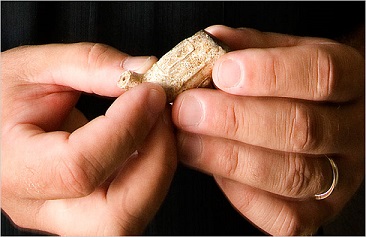
This pipe was instrumental in archaeologists’ identification of the site of George Washington’s boyhood home. Photo: Adrian Coakley/National Geographic.
For me this connects to an old cause of mine–defending the value of what Near Eastern archaeologists sometimes scoffingly refer to as “relics.” These professionals are interested only in what their finds can tell us about the past, not simply that something may be related to King David—or George Washington. Who cares about the exact location of where George Washington lived as a boy? So what if he smoked this particular pipe?
In the case of the excavation to locate George Washington’s boyhood home, no one suggested that this enormous effort was not worth the prize. No one suggested that the archaeologists should instead have concentrated on learning more about how people lived when George Washington was a boy, instead of discovering precisely the location of the boyhood home of the father of his country.
For me, the contrast between this situation and the search for King David’s palace is stark.
Our free eBook Ten Top Biblical Archaeology Discoveries brings together the exciting worlds of archaeology and the Bible. Learn the fascinating insights gained from artifacts and ruins, like the Pool of Siloam in Jerusalem, where the Gospel of John says Jesus miraculously restored the sight of the blind man, and the Tel Dan inscription—the first historical evidence of King David outside the Bible.
Israeli archaeologist Eilat Mazar had only one shot, not three. In an article in BAR, she pinpointed a location in the most ancient part of Jerusalem where she thought the Israelite king’s palace should be located.2 From the outset, some “sophisticated” archaeologists denigrated the idea. This was not “real” archaeology. Anthropological questions, not historical questions were the order of the day. Archaeologists should be looking for answers to broader questions, not narrower historical questions like where King David had his palace—of course, adding, “if he lived,” or “if he had a palace,” or “if he had a kingdom.”
A New York businessman was interested in whether Eilat Mazar’s suggestion was sound, so he financed her dig. Politically, he leaned to the right and this became the basis for deprecating the excavation—as if Eilat Mazar would trim her findings to satisfy the funder’s politics. This is a dastardly charge for which there is no basis. (This charge was repeated against another distinguished archaeologist, Ronny Reich, who was working elsewhere in the City of David; Ronny Reich happens to be “a man of the left”—his own characterization—although his work is supported by a right-wing organization.)

The so-called Large Stone Structure is identified as remains of King David’s palace in the City of David by its excavator, Eilat Mazar. Photo: Eilat Mazar.
Well, Eilat Mazar has found a major building with walls 6 to 8 feet thick. The building is surely worthy of being a palace.3 She has also found strong evidence that the building was used in King David’s time. But the date is not 100 percent certain. We would all like even better evidence than what we have. This raises a legitimate question—and Eilat Mazar recognizes this. She nevertheless quite convincingly contends that this is very probably King David’s palace. Like so many conclusions in archaeology, a certain uncertainty remains. Critics of Eilat Mazar, however, have treated her in the same breath as I-found-Noah’s-Ark crazies, as if she were making some off-the-wall argument.
I compare the reaction of these “scientific” archaeologists to Eilat Mazar’s excavation of David’s palace with the reaction of American archaeologists to the discovery of the remains of George Washington’s boyhood home. Why the difference, I ask myself.
For some archaeologists, there is something apparently “unscientific,” not sophisticated, about an interest in the Bible, as if this interest can only be religious, not simply an effort to look dispassionately at the evidence. There is a suspicion that if you look to archaeology to inform the Bible, you hail from another generation that was out to prove the Bible, rather than simply to look at the evidence. There is something “cool” about not being interested in the Bible. It’s the same mindset that denigrates an artifact that might have been used in the Temple as nothing more than a “relic” or a “curiosity,” not something that “real” archaeologists would value.
So have I connected George Washington to Biblical archaeology? Have a happy Fourth.
Read Eilat Mazar’s article “Did I Find King David’s Palace?” for free as it was originally published in BAR.
Notes
1 John Noble Wilford, “Washington’s Boyhood Home Is Found,” New York Times, July 3, 2008, accessed June 6, 2014, www.nytimes.com/2008/07/03/science/03george.html.
2 Eilat Mazar, “Excavate King David’s Palace!” BAR, January/February 1997.
3 Eilat Mazar, “Did I Find King David’s Palace?” BAR, January/February 2006.
Related Posts


Must-Read Free eBooks

Want more Bible history?
Sign up to receive our email newsletter and never miss an update.
Unlock Unlimited Access to the Bible's Past

Unlock Unlimited Access to the Bible's Past
Become an All-Access Member to explore the Bible's rich history. Get Biblical Archaeology Review in print, full online access, and FREE online talks. Plus, enjoy special Travel/Study discounts. Don't miss out—begin your journey today!

Wonderful article! You definitely connected Mr. Washington to Biblical archaeology.
You hit the stone (nail) on the head with this explanation. I’m sure they’d rather have the hatchet – but the masonic pipe was close enough. I’d call your article a nice curve ball (unexpected but still a strike). Soli Deo Gloria. And may God Bless America (nobody else wants to).
Musicians often say that whether one is a Christian or not, there is a period of several hundred years when only Christian music was written. They ask, should we ignore hundreds of years of history because we are not Christians? The same question arises to historians. For many historical periods in the near east there are few, if any recorded histories. Whether you are a Christian, or a Jew, or not, should you ignore one of the few written records that we have?
“For some archaeologists, there is something apparently “unscientific,” not sophisticated, about an interest in the Bible, as if this interest can only be religious, not simply an effort to look dispassionately at the evidence.” Great observation, and one that Dr. Steven Collins certainly has faced: even though he has multiple points of congruence between Genesis and massive Tall el Hammam, the discovery and well-documented multiple seasons of excavation of the largest city of its time in the southern Levant has never generated the discussion that “Washington’s pipe” has done.
It is called antisemitism.
There are no Scriptures or any ancient writings anywhere with more historicity than the Hebrew. Name one?
I enjoyed the 4th of July connection!
Most definitely you made a connection.
I guess those who found Washington’s boyhood home could say they found the boyhood home of the Father of America, Mystery Babylon the Great. It is no secret who the founding fathers worshipped and how much they hated Christianity. I am not surprised the world lifts up their own while putting down those who belong to the household of God.
Watch “The Hidden Faith of The Founding Fathers” for an eye opener. It can be purchased or watched freely on YouTube.
.
King David’s palace?
In reality King David’s palace was in Zoan, not Zion. There you will find a king of the 10th century BC who was famed and named for a star (Star of David) and his city (City of David).
His name was King Pa-Duat-Khayan-Nuit (meaning, My star Rises in my City). And it is from the name Duat, that David was derived.
Oh, and his daughter was called Makhare MuTahmat (Machah Tamar). See ‘Solomon, Pharaoh of Egypt’.
.
Before 1993, there was no proof outside the Bible to support the historicity of David, the brave young shepherd who later became king of Israel. That year, however, archaeologists uncovered in northern Israel a basalt stone, dated to the ninth century B.C.E., that experts say bears the words “House of David” and “king of Israel.”
http://wol.jw.org/en/wol/d/r1/lp-e/1200271570
http://wol.jw.org/en/wol/d/r1/lp-e/1200270452#h=56:0-56:0