Love Your Neighbor: Only Israelites or Everyone?
From the September/October 2014 issue of Biblical Archaeology Review
Richard Elliott Friedman
February 14, 2026
35 Comments
70883 views

Rembrandt, Moses with the Tablets of the Law, public domain.
Moses, pictured here in a painting by 17th-century Baroque artist Guido Reni, is one of the most iconic figures in the Hebrew Bible. Despite Moses’ obvious Semitic heritage, the name “Moses” is actually Egyptian, like that of other Biblical figures (Phinehas, Hophni, Hur, Merari). All of them are referred to in the Bible’s Levite sources (E, P and D of the Documentary Hypothesis). Levites like Moses fled Egypt to form a new nation of Israelites who were to “love your neighbor.”
It’s one of the most famous lines in the Bible: “Love your neighbor as yourself” (Leviticus 19:18).
Impressive. Fascinating. Inspiring. Capable of a thousand interpretations and raising 10,000 questions. A remarkable proposition coming out of ancient Judah, which was embedded in the Near Eastern world of wars, slavery, class and ethnic divisions and discriminations of all kinds.
One interpretation of this verse that has been making the rounds for years turns this grand idea on its head: The claim is that the verse means to love only one’s fellow Israelites as oneself. Instead of being inclusive, it’s actually exclusive. Is there anything to this claim?
We have to start by going all the way back to the Exodus, which the combination of archaeology and text has led me to argue was historical; it actually happened. Ninety percent of the arguments against its historicity are not about the event itself but about the size of the event: All of Israel! Two million people (as suggested by Exodus 12:37–38)! Impossible!
But the evidence of a real but smaller exodus is a different matter. The earliest Biblical sources—the very early Song of Miriam (Exodus 15) and the text known in critical Biblical scholarship as J—don’t mention any numbers.
Moreover, there is good evidence that only the Levites were in Egypt; it was they who left and then merged with the rest of Israel. Note that only Levites have numerous Egyptian names (e.g., Phinehas, Hophni, Hur, Merari, Moses). The Levites alone reflect Egyptian material culture: Their Tabernacle has parallels with the battle tent of Pharaoh Rameses II.1 Their ark has parallels with Egyptian sacred barks.2 The Levite sources alone require circumcision, which was practiced in Egypt. There is much more. For the whole picture, see my presentation at a recent conference titled Out of Egypt held last year at the University of California, San Diego, which BAR has put online at https://www.biblicalarchaeology.org/daily/biblical-topics/exodus/video-the-exodus-based-on-the-sources-themselves/.

FREE ebook: Ancient Israel in Egypt and the Exodus.
One more mark of the Levite sources is crucial and will bring us back now to the interpretation of “Love your neighbor as yourself.” Is neighbor exclusive or inclusive?
Of the four sources of the Torah or Pentateuch that critical scholars refer to as J, E, P and D,a three—E, P (the Priestly source) and D (the Deuteronomistic source)—are Levite sources. In these Levite sources, the command to treat aliens fairly comes up 52 times! (How many times does this come up in the non-Levite source, J? Answer: None.)
The first occurrence of the word torah in the Torah is: “There shall be one torah for the citizen and for the alien who resides among you” (Exodus 12:49, from the Levite source P).
Why this frequent concern for aliens? We might reasonably guess that it was a matter of geography. Israel lay at the point where Africa, Asia and Europe meet. People of all backgrounds regularly passed through. So we can imagine a nation at that fulcrum of ancient trade routes having a policy of welcome to all those valuable aliens. Still, not all countries that have desired the benefits of trade have emphasized this principle. Again and again, all three Levite sources of the text (E, P and D) rather give this reason:
And you shall not persecute an alien, and you shall not oppress him, because you were aliens in the land of Egypt.
Exodus 22:20
And you shall not oppress an alien — since you know the alien’s soul, because you were aliens in the land of Egypt.
Exodus 23:9
You shall not persecute him. The alien who resides with you shall be to you like a citizen of yours, and you shall love him as yourself, because you were aliens in the land of Egypt.
Leviticus 19:33–34
So you shall love the alien, because you were aliens in the land of Egypt.
Deuteronomy 10:19
You shall not abhor an Egyptian, because you were an alien in his land.
Deuteronomy 23:8
You shall not bend judgment of an alien … You shall remember that you were a slave in Egypt, and YHWH, your God, redeemed you from there. On account of this I command you to do this thing.
Deuteronomy 24:17–18
Why should we be good to aliens? Because we know how it feels. We know the alien’s soul. So we won’t persecute foreigners; we won’t abhor them; we won’t oppress them; we won’t judge them unfairly; we’ll treat them the same as we treat ourselves; we’ll love them.
Indeed, one possible meaning of the word Levi in Hebrew is “alien.”3
It is certainly true that there are also some harsh passages toward foreigners in the Bible: Dispossess the Canaanites, destroy Jericho, etc. But the evidence in the ground, discussed and debated many times in BAR’s pages, indicates that most of that (the so-called Conquest of the land) never happened.b Moreover in far more laws and instances, the principle of treatment of aliens is positive.
For example: Don’t rape a captured woman in war (Deuteronomy 21:10ff).
Don’t abhor an Edomite (Deuteronomy 23:8).
If you happen upon your enemy’s ox or donkey straying, bring it back to him.
If you see the donkey of someone who hates you sagging under its burden, and you would hold back from helping him: You shall help him (Exodus 23:4–5).
The Bible permits a violent response to those who threaten Israel’s existence, but it still forbids a massacre if they surrender.
The very fact that the Bible’s sources start off with the creation of the earth and all of humankind instead of starting with Israel itself is relevant here. If any of us were asked to write a history of the United States, would we start by saying, “Well, first there was the Big Bang, and then …”? The Biblical authors saw Israel’s destiny as being to bring good to all those foreign nations and peoples—to the earth. It is not a minor point. It appears in God’s first words to Abraham, in God’s first words to Isaac, and in God’s first words to Jacob: Your descendants’ purpose is to be that “all the nations/families of the earth will be blessed through you” (Genesis 12:3; 26:2–4; 28:10–14).
Which brings me back to the opening question: Is “Love your neighbor as yourself” meant exclusively or inclusively? Does this admonition refer only to your Israelite neighbor or to all humankind?
When the text already directs every Israelite to love aliens as oneself, what would be the point of saying to love only Israelites—in the very same chapter! Now my friend Jack Milgrom, of blessed memory, wrote that it is precisely because the love of the alien is specifically mentioned there that love of “neighbor” must mean only a fellow Israelite.4
I see his point, but his position would have been more likely if the verse about love of aliens had come first in the text and the love of neighbor had came later. But the instruction to love aliens comes after we’ve already had the instruction to love your neighbor as oneself. That is, if you tell people first to love their aliens and then give a second instruction to love their neighbors, that second instruction really does sound like an addition because the first group, aliens, obviously doesn’t include the second group, neighbors. But if you tell people first to love their neighbors, then a second instruction to love aliens a few verses later can make sense as a specification for anyone who would have thought that love of neighbor didn’t include loving others as well.
Watch full-length lectures from the Out of Egypt: Israel’s Exodus Between Text and Memory, History and Imagination conference, which addressed some of the most challenging issues in Exodus scholarship. The international conference was hosted by Calit2’s Qualcomm Institute at UC San Diego in San Diego, CA.
Did the Biblical authors think that the specifications referring to aliens were necessary? We know that they did because they said it 52 times in the Torah! And, in any case, Milgrom and I would both recognize that the bottom line is that one is supposed to love both, alien and neighbor, whether they overlap or not.
So from where did the idea come, that the Hebrew word for neighbor in this verse, re‘a, means only a member of one’s own group? We can get a better idea of what the Hebrew word for neighbor, re‘a, means by looking at other places in the Bible where this word is used.
The first occurrence of re‘a is in the story of the tower of Babel (Babylon). It is the Bible’s story of the origin of different nations and languages. It involves every person on earth: “And they said each to his re‘a …” (Genesis 11:3). That is, the term refers to every human, without any distinctions by group.
Now, one might say, though, that the word might still refer only to members of one’s own group because, at this point in the story, all humans are in fact still members of a single group. So let’s go to the next occurrence of the word. In the story of Judah and Tamar, Judah has a re‘a named Hirah the Adullamite (Genesis 38:12, 20). Hirah is a Canaanite! He comes from the (then) Canaanite city of Adullam. He cannot be a member of Judah’s clan because, at this point in the story, that clan, namely the Israelites, consists only of Jacob and his children and any grandchildren.
In Exodus 11:2 the word appears in both the masculine and feminine in the account of how the Israelites are instructed to ask their Egyptian neighbors for silver and gold items before their exodus from Egypt. The word there refers quite precisely to non-Israelites. In Exodus 2:13, on the other hand, in the story of Moses’ intervention between two “Hebrews” who are fighting, he says to the one at fault, “Why do you strike your re‘a?” So in that episode it refers to an Israelite.
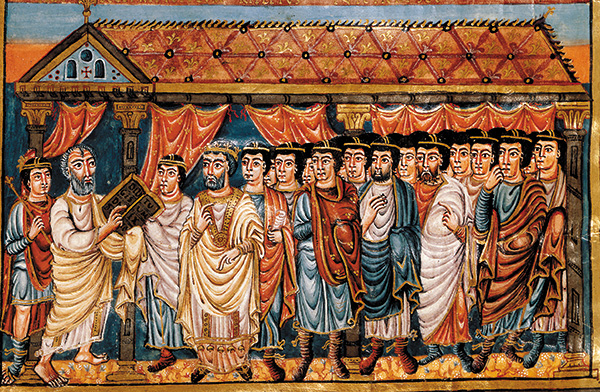
Snark/Art Resource, NY
TEACHING THE LAW. In this ninth-century illustration from the Bible of Charles the Bald, Moses explains the law to the Israelites. Fifty-two occurrences in the Bible’s Levite texts (E, P and D) refer to the importance of treating foreigners fairly—no distinction between an Israelite and a non-Israelite. “Love your neighbor as yourself” is also from a Levite text. Considering this pervasive Levite stress on the fair treatment of the alien, why would a Levite text then say you only need to love an Israelite “neighbor”? Our author believes it doesn’t—“neighbor” includes all humankind.
In short, the word re‘a is used to refer to an Israelite, a Canaanite, an Egyptian, or to everyone on earth.
And still some people say that “Love your re‘a as yourself” means just your fellow Israelite. When the Ten Commandments include one that says: “You shall not bear false witness against your re‘a” (Exodus 20:16; Deuteronomy 5:17), do they think that this meant that it was okay to lie in a trial if the defendant was a foreigner (even though elsewhere, as we saw, the law forbids Israel to “bend the judgment of an alien”)? When another of the Ten Commandments says not to covet your re‘a’s wife (Exodus 20:17; Deuteronomy 5:18), do they think that this meant that it was okay to covet a Hittite’s wife (even though elsewhere the Bible condemns King David for doing just that)?
Those who contend that “neighbor” refers only to one’s neighbors of your own people frequently cite its context. They quote the sentence that precedes the sentence about loving one’s neighbor. Looking at the two together, it reads like this:
You shall not take revenge, and you shall not keep on at the children of your people.
And you shall love your neighbor as yourself.
Since the two sentences were put together into a single verse when verse numbers were added to the Bible, some interpreters have assumed that the “love your neighbor as yourself” line must also be just about “the children of your people.” Why? No reason at all. Read Leviticus 19, carefully. Coming near the very center of the Torah, it is a remarkable mixture of laws of all kinds. It goes back and forth between ethical laws and ritual laws: sacrifice, heresy, injustice, mixing seeds, wearing mixed fabrics (shaatnez), consulting the dead, gossip, robbing, molten idols, caring for the poor. It has everything! I tell my students that if you’re on a desert island and can have only one chapter of the Bible with you, make it Leviticus 19. And its laws all come mixed in between each other. No line can be judged by what comes before it or after it. And, remember, there are no verse numbers or periods or commas in the original.
For more on the Book of Leviticus, read “What Does the Bible Say About Tattoos?” and “Book of Leviticus Verses Recovered from Burnt Hebrew Bible Scroll.”
The much respected Bible scholar Harry Orlinsky made the context argument in 1974.5 Because of his scholarly standing, he was followed by others. Robert Wright cited him in The Evolution of God.6 Wright had consulted with me on the matter of loving the alien, but unfortunately we didn’t discuss the “neighbor” verse; if we had, I would have cautioned him. Hector Avalos also followed Orlinsky, saying “as Orlinsky has deftly noted …”7 The “deftly noted” remark has been used (and often quoted) over and over again in connection with the interpretation of this verse. It was not deft at all.
The same “context” mistake was made by John Hartung, an evolutionary anthropologist8 who was cited and followed by Richard Dawkins in his bestselling The God Delusion, saying, “‘Love thy neighbor’ didn’t mean what we now think it means. It meant only ‘Love another Jew.’”9 Hartung emphasized the importance of context, but he then used only the one verse (quoted above), seemingly unaware that the joining of its two statements was done by those who created numbered verses centuries after the Bible was written.
“Love your neighbor as yourself” remains: Famous. Impressive. Fascinating. Inspiring. You can accept or challenge it. And you can decide whether you will follow it in your own life. But don’t change what it means.
“Love Your Neighbor: Only Israelites or Everyone?” by Richard Elliott Friedman was originally published in the September/October 2014 issue of Biblical Archaeology Review. It was first republished in Bible History Daily on August 19, 2014.
 Richard Elliott Friedman is the Ann and Jay Davis Professor of Jewish Studies at the University of Georgia and Katzin Professor of Jewish Civilization Emeritus at the University of California, San Diego, and author of the classic Who Wrote the Bible? (1987). He was a visiting fellow at Cambridge and Oxford, a senior fellow of the American Schools of Oriental Research in Jerusalem, a visiting professor at the University of Haifa and participated in the City of David Project archaeological excavations of Jerusalem.
FREE ebook: Ancient Israel in Egypt and the Exodus.
Notes
a. Richard Elliott Friedman, “Taking the Biblical Text Apart,” Bible Review, Fall 2005.
b: Aharon Kempinski, “Israelite Conquest or Settlement? New Light from Tell Masos,” BAR, September 1976;
- Yigael Yadin, “Israel Comes to Canaan: Is the Biblical Account of the Israelite Conquest of Canaan Historically Reliable?” BAR, March/April 1982;
- Ziony Zevit, “The Problem of Ai,” BAR, March/April 1985;
- David Ussishkin, “Lachish—Key to the Israelite Conquest of Canaan?” BAR, January/February 1987;
- Bryant G. Wood, “Did the Israelites Conquer Jericho? A New Look at the Archaeological Evidence,” BAR, March/April 1990;
- Hershel Shanks, “When Did Ancient Israel Begin?” BAR, January/February 2012;
- Amnon Ben-Tor, “Who Destroyed Canaanite Hazor?” BAR, July/August 2013.
1. Michael Homan, To Your Tents O Israel (Leiden: Brill, 2002), pp. 111–115.
2. Scott Noegel demonstrated this in an impressive paper at the Out of Egypt conference: “The Ark of the Covenant and Egyptian Sacred Barks: A Comparative Study” (conference, San Diego, May 31–June 9, 2013).
3. William Propp, Exodus 1–18, The Anchor Bible (New York: Doubleday, 1999), p. 128.
4. Jacob Milgrom, Leviticus 17–22, The Anchor Bible (New York: Doubleday, 2000), p. 1654; and see bibliography there.
5. Harry Orlinsky, Essays in Biblical Culture and Bible Translation (New York: Ktav, 1974), p. 83.
6. Wright cited him in The Evolution of God (New York: Little, 2009), pp. 235–236.
7. Hector Avalos, Fighting Words: The Origins of Religious Violence (Amherst, NY: Prometheus Books, 2005), p. 140.
8. John Hartung, “Love Thy Neighbor: The Evolution of In-Group Morality,” Struggles for Existence (blog), (strugglesforexistence.com/?p=article_p&id=13).
9. Dawkins, The God Delusion (Boston: Houghton Mifflin Co., 2006), p. 253.
Related Posts


Must-Read Free eBooks



Want more Bible history?
Sign up to receive our email newsletter and never miss an update.
Unlock Unlimited Access to the Bible's Past

Unlock Unlimited Access to the Bible's Past
Become an All-Access Member to explore the Bible's rich history. Get Biblical Archaeology Review in print, full online access, and FREE online talks. Plus, enjoy special Travel/Study discounts. Don't miss out—begin your journey today!

The writer’s idea is derived from the use of isagesis and eisagesis.
The original context is Leviticus 19. Here’s the pericope:
“15 ‘You shall do no injustice in judgment; you shall not be partial to the poor nor defer to the great, but you are to judge your neighbor fairly. 16 ‘You shall not go about as a slanderer among your people, and you are not to act against the life of your neighbor; I am the LORD. 17 ‘You shall not hate your fellow countryman in your heart; you may surely reprove your neighbor, but shall not incur sin because of him. 18 ‘You shall not take vengeance, nor bear any grudge against the sons of your people, but you shall love your neighbor as yourself; I am the LORD.” (Leviticus 19:15-18 NAS)
Clearly, the context is legal not political or emotional-social.
What do you suppose the proper meaning of this LEGAL TEXT is?
The writer arrived at his meaning of Matthew 5 through the use of isagesis and eisagesis.
The context of Matthew 5 is LEGAL. The principle Y’shuah promotes in this ‘teaching’ is the same as the juridical foundations of the American republic. America’s founding fathers relied on a doctrine popularly known as “equal application of the law to everybody”. That’s the meaning of Y’shuah’s statement in Matthew 5, NOT treating foreigners w/social-emotional love. Any good Jew would recognize the latter to fall under the category of CHARITY. Charity is a MITZVOT, not a legal prescription, unless it was based on a VOW (another part of the “Levrite” law).
How much honor does a teacher like the above writer have when he violates the basic principle of hermeneutics in creating his Biblical interpretations? Or maybe one of the Rockefeller’s or Carnegie’s stooges paid this man in via system of propaganda to promote “loving treatment of foreigners” in today’s America, which is suffering from the politics associated w/a massive influx of ILLEGAL ALIENS, perpetrated by the central government itself?
Y’shuah had a word for this: “wolves in sheep’s clothing” (Matthew 7.5)
BAR: You should be ashamed of yourselves for promoting such frivolous and seditious political propaganda. What happened to the separation of church and state? Such hypocrisy, don’t you think?
Cheers … Chris
You all know the tribes which had been banned. They had been the neighbors of the Hebrews living in Kanaan and neighborhood. More than 3,5 mio had been killed by the Hebrews. – This according to the bible. Is this the way of loving your neighbors? See also Lev 21 16-23: is that the way how to love neighbors and own people and treatening handicaped? Nowadays that will be punished because of discrimation. And what about the slaves? Is slavery gods way of loving people? Why Moses gave even laws for slavery? They had been slaves themselves but keeping their own slaves?! – How many returned from exile? – Even proudly mentioning the amount of slaves kept by the Jews. And Salomon? 600.000 slaves worked for him in the stoneworks. Even own people god killed (Num 17.14). I could continue several pages, but believers are blind . In my books I wrote on 600 pages all the cruelity of Jahwe. So, where is the love? Ok, the Quran ist even worser. No doubt. But the brutality is the same.
Johan… that is the word when Christians don´t know any answer as they missed in bible school. But you don´t even know where the word AMEN is originated from: AMENOTEP… Egyptian god-pharoh… It was a battle call. So maybe you should use and select your words more carefully.
I think the real problem here is that Israel of today forgets that they were the chosen ones, due to a promise to Abraham, to become the nation of God/Jehovah who would lead the world to salvation for it was always the will of God that all mankind be restored to Him if possible. Israel was chosen to be the one to eventually bring all God’s converts to know Him accurately and obey Him. As such chosen ones, they needed to develop a heart and attitude of love and acceptance of people of all the nation, all who come from Adam and need to be taught about God.
Israel was supposed to be bigger and better than the nations, by being kind and just to all. But Israel herself never learned or accepted obedience, so she scorns love of neighbor, those who are not Jews. Not all Jews do that but a significant number do. So God had to appoint another to fulfill the prophecies in a symbolic figurative way, as shown in Deuteronomy, chapters 28-32. So love for all, without distinctions or preferences, is the goal we should all pursue, for our service should be that which is in behalf of God, not political ambitions, the the selfish ambitions of a few wealthy types who want to be exclusive and superior.
It is vital to always keep the big original picture in mind. Israel or “Israel” will bring God to all, but not all will accept. We accept any who do embrace God and their fellow men (which naturally includes women in that “men” reference.
hi jurgen We the disciples of yeshua will pray for you so that your eyes may be opened for the truth. do you believe in the prophet? e.g HIS servant Moses Isiah,Daniel, e.t.c
all of them spoke the WORD of GOD And all spoke about Him .you do not believe in HIS WORD. do think you can make us believe your( mans) word.For HE say my thoughts are not your thoughts.to us Yeshua is The WORD of GOD when we heard Him we believed Him.i boldly testify that His word is true. I ask you to try it e.g hate your neighbor and he will pay you back in the same currency. is not this the law?God tells you to love In Matthew 5:44-48 Jesus makes it clear: “My command to you is: love your enemies, pray for your persecutors. This will prove that you are children o your heavenly father, for his sun rises on the bad and the good. He rains on the just and unjust. If you love those who love you, what merit is there in that? Do not tax collectors do as much? And if you greet your brothers only, what is so praiseworthy about that? Do not pagans do as much? You must be made perfect as your heavenly father is perfect.” Then, in Luke 6:27-36 “But to you who hear I say, lover your enemies, do good to those who curse you, pray for those who mistreat you. To the person who strikes you on one cheek, offer the other one as well, and from the person who takes your cloak, do not withhold your tunic. Give to everyone who asks of you, and from the one who takes what is yours, do not demand it back. Do to others what you would have them do to you. For if you love those who love you, what credit is that to you? Even sinners love those who love them. And if you do good to those who do good to you, what credit is that to you? Even sinners do the same. If you lend money to those from whom you expect repayment, what credit is that to you? Even sinners lend to sinners and get back the same amount. But rather, love your enemies and do your neighbor in the way He has specified. this is purely for your own good Lev 19:17 ‘You shall not hate your fellow countryman in your heart; you may surely reprove your neighbor, but shall not incur sin because of him.so my bro. because of your thoughts you have hated GOD thoughts repent now and you will start a journey to enter GODS kingdom which has already come,
This is typical of a writer that babbles on and on and then leaves people in the lurch by telling them decide for yourself. Of course your God given heart says like our Lord Christ told us. Why pick it apart and put it under a microscope only to say really nothing!
He doesn’t say decide he says discover.. because GOD’S work is evident in our lives. His grace is upon us when we believe in him. We don’t decide about GOD we witness or experience. If you reject GOD then you are setting yourself up for a bleak existence and death and an eternity in hell.
So much fighting who right or wrong put that aside and come together from those that make us slave from this world!!
Perhaps we can never be sure of the original intention or actual interpretation of the idea in ancient Israel but what seems to be of more importance is how we might interpret the idea of “neighbor” today as well as what that passage means to us in how we choose to extend our kinship network.
If you want to feel good will to everyone, better avoid affiliating with any and all religions. That’s the impression that I, as a non religious person certainly feel strongly reading the opinions put forth here. Most comments seem more like online flaming than civil discussion. If religious people can’t speak courteously and, yes, even lovingly each to the other, are they helping or hurting the ability, in the face of climate change, loss of species, and perhaps worst, extremely violent current and past religious wars, of humanity to at the bare least, survive? A sectarian spirit no longer serves anyone, if it ever did. “Can’t we just get along” folks? as Rodney King, for those of us old enough to remember, once said. Altruism and empathy should be humanity’s watchwords, if we are going to be able to survive present and still more urgent challenges of the future!