What’s Missing from Codex Sinaiticus, the Oldest New Testament?
Compare differences between the King James Version and Codex Sinaiticus
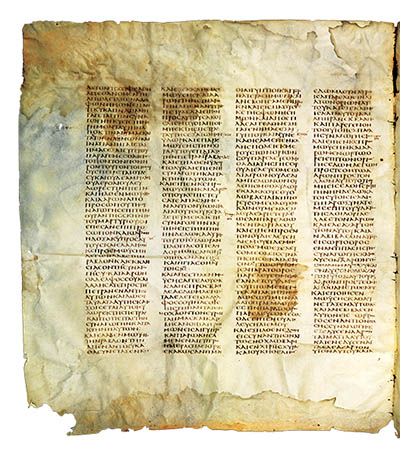
A salvaged page of the Codex Sinaiticus from St. Catherine’s Monastery recovered in 1975. Photo: Courtesy of St. Catherine’s Monastery.
Two hundred years after Constantine Tischendorf’s birth, questions remain as to the conditions of his removal of Codex Sinaiticus from St. Catherine’s Monastery. Dating to the mid-fourth century C.E., Codex Sinaiticus is the oldest complete manuscript of the New Testament.
In his article “Hero or Thief? Constantine Tischendorf Turns Two Hundred” in the September/October 2015 issue of Biblical Archaeology Review, Stanley E. Porter contends that Tischendorf should be considered a hero, not a thief.
The text of Codex Sinaiticus differs in numerous instances from that of the authorized version of the Bible in use during Tischendorf’s time. For example, the resurrection narrative at the end of Mark (16:9–20) is absent from the Codex Sinaiticus. So is the conclusion of the Lord’s Prayer: “For thine is the kingdom and the power and the glory forever. Amen” (Matthew 6:13). The woman caught in adultery from John 8 is omitted in Codex Sinaiticus.
According to James Bentley, Tischendorf was not troubled by the omission of the resurrection in Mark because he believed that Matthew was written first and that Mark’s gospel was an abridged version of Matthew’s gospel. If this were true, the absence of resurrection in Mark would not be a problem because it appears in the older Matthean gospel. Modern scholarship generally holds that Mark is in fact the oldest of the Synoptic Gospels, which could cause theological concerns over the omitted resurrection.
FREE ebook: The Holy Bible: A Buyer's Guide 42 different Bible versions, addressing content, text, style and religious orientation.
One other omission in Codex Sinaiticus with theological implications is the reference to Jesus’ ascension in Luke 24:51. Additionally, Mark 1:1 in the original hand omits reference to Jesus as the Son of God.
Below, see a visual comparison of these and other differences between the King James Version and Codex Sinaiticus.
The Markan Resurrection
(Mark 16: 1–14)
2 And very early in the morning the first day of the week, they came unto the sepulchre at the rising of the sun.
3 And they said among themselves, Who shall roll us away the stone from the door of the sepulchre?
4 And when they looked, they saw that the stone was rolled away: for it was very great.
5 And entering into the sepulchre, they saw a young man sitting on the right side, clothed in a long white garment; and they were affrighted.
6 And he saith unto them, Be not affrighted: Ye seek Jesus of Nazareth, which was crucified: he is risen; he is not here: behold the place where they laid him.
7 But go your way, tell his disciples and Peter that he goeth before you into Galilee: there shall ye see him, as he said unto you.
8 And they went out quickly, and fled from the sepulchre; for they trembled and were amazed: neither said they any thing to any man; for they were afraid.
9 Now when Jesus was risen early the first day of the week, he appeared first to Mary Magdalene, out of whom he had cast seven devils.
10 And she went and told them that had been with him, as they mourned and wept.
11 And they, when they had heard that he was alive, and had been seen of her, believed not.
12 After that he appeared in another form unto two of them, as they walked, and went into the country.
13 And they went and told it unto the residue: neither believed they them.
14 Afterward he appeared unto the eleven as they sat at meat, and upbraided them with their unbelief and hardness of heart, because they believed not them which had seen him after he was risen.
15 And he said unto them, Go ye into all the world, and preach the gospel to every creature.
16 He that believeth and is baptized shall be saved; but he that believeth not shall be damned.
17 And these signs shall follow them that believe; In my name shall they cast out devils; they shall speak with new tongues;
18 They shall take up serpents; and if they drink any deadly thing, it shall not hurt them; they shall lay hands on the sick, and they shall recover.
19 So then after the Lord had spoken unto them, he was received up into heaven, and sat on the right hand of God.
20 And they went forth, and preached every where, the Lord working with them, and confirming the word with signs following. Amen.
2 And very early in the morning the first day of the week, they came unto the sepulchre at the rising of the sun.
3 And they said among themselves, Who shall roll us away the stone from the door of the sepulchre?
4 And when they looked, they saw that the stone was rolled away: for it was very great.
5 And entering into the sepulchre, they saw a young man sitting on the right side, clothed in a long white garment; and they were affrighted.
6 And he saith unto them, Be not affrighted: Ye seek Jesus of Nazareth, which was crucified: he is risen; he is not here: behold the place where they laid him.
7 But go your way, tell his disciples and Peter that he goeth before you into Galilee: there shall ye see him, as he said unto you.
8 And they went out quickly, and fled from the sepulchre; for they trembled and were amazed: neither said they any thing to any man; for they were afraid.
The Lord’s Prayer
(Matthew 6:9–13)
10 Thy kingdom come, Thy will be done in earth, as it is in heaven.
11 Give us this day our daily bread.
12 And forgive us our debts, as we forgive our debtors.
13 And lead us not into temptation, but deliver us from evil: For thine is the kingdom, and the power, and the glory, for ever. Amen.
Hallowed be thy name,
Thy kingdom come. Thy will be
done in earth, as it is in heaven.
Give us this day our daily bread.
And forgive us our debts, as we
forgive our debtors.
And lead us not into temptation,
but deliver us from evil.
The woman caught in adultery
(John 7:53–8:11)
8:1 Jesus went unto the mount of Olives.
2 and early in the morning he came again into the temple, and all the people came unto him: and he sat down, and taught them
3 And the scribes and Pharisees brought unto him a woman taken in adultery; and when they had set her in the midst,
4 They say unto him, Master, this woman was taken in adultery, in the very act.
5 Now Moses in the law commanded us, that such should be stoned: but what sayest thou?
6 This they said, tempting him, that they might have to accuse him. But Jesus stooped down, and with his finger wrote on the ground, as though he heard them not.
7 So when they continued asking him, he lifted up himself, and said unto them, He that is without sin among you, let him first cast a stone at her.
8 And again he stooped down, and wrote on the ground.
9 And they which heard it, being convicted by their own conscience, went out one by one, beginning at the eldest, even unto the last: and Jesus was left alone, and the woman standing in the midst.
10 When Jesus had lifted up himself, and saw none but the woman, he said unto her, Woman, where are those thine accusers? Hath no man condemned thee?
11 She said, No man, Lord. And Jesus said unto her, Neither do I condemn thee: go, and sin no more.
Significant omitted verses
Mark 1:1: “The beginning of the gospel of Jesus Christ, the Son of God;”
Luke 9:55–56: “But he turned, and rebuked them, and said, Ye know not what manner of spirit ye are of. For the Son of man is not come to destroy men’s lives, but to save them. And they went to another village.”
Mark 1:1 Adds the phrase “the Son of God” only above the line, as a later addition.
Luke 9:55–56: “But he turned and rebuked them. And they went to another village.”
Alterations perhaps due to later theological beliefs
Constantine Tischendorf’s chance finding of Codex Sinaiticus, the oldest New Testament manuscript, at St. Catherine’s Monastery in the Sinai—and his later removal of the manuscript—made him both famous and infamous. Learn more by reading “Tischendorf on Trial for Removing Codex Sinaiticus, the Oldest New Testament.”
This Bible History Daily feature was originally published on August 12, 2015. Biblical quotations corrected on September 18, 2022.
Become a BAS All-Access Member Now!
Read Biblical Archaeology Review online, explore 50 years of BAR, watch videos, attend talks, and more

Related reading in Bible History Daily
What’s Missing from Codex Sinaiticus, the Oldest New Testament?
Tischendorf on Trial for Removing Codex Sinaiticus, the Oldest New Testament
All-Access members, read more in the BAS Library
Not a BAS Library or All-Access Member yet? Join today.
Related Posts


Must-Read Free eBooks
Want more Bible history?
Sign up to receive our email newsletter and never miss an update.
Unlock Unlimited Access to the Bible's Past

Unlock Unlimited Access to the Bible's Past
Become an All-Access Member to explore the Bible's rich history. Get Biblical Archaeology Review in print, full online access, and FREE online talks. Plus, enjoy special Travel/Study discounts. Don't miss out—begin your journey today!

Well, well, here we go again.
Anything that gets into the public arena gets trashed, but in a way it makes me happy to read all the responses, because it tells me that there are still passionate people out there who are looking for the resurrected Jesus to appear.
BAR, you are supposed to be a scholarly magazine. When you allow biased comments like this:
“Modern scholarship generally holds that Mark is in fact the oldest of the Synoptic Gospels, which could cause theological concerns over the omitted resurrection. One other omission in Codex Sinaiticus with theological implications is the reference to Jesus’ ascension in Luke 24:51. Additionally, Mark 1:1 in the original hand omits reference to Jesus as the Son of God.”
I want to cringe. You know perfectly well that the omission of these texts in no way theologically threatens any Biblical doctrine. Mentioning of Jesus’ resurrection and his identity as the “Son of God” and even as the “I am” are found in numerous other passages in the “Codex Sinaiticus.” Why have you chosen to have an article about “What’s missing….” with 2 passages (John 8 and Mark 1) we already knew were out of several manuscripts? This is old news for many.
Why not do an article as well featuring “What’s included in Codex Sinaiticus” which includes Jesus’ exalted position in Revelation, being referenced as the Son of God in many other parts of the gospels, the fact that Mark leaves with someone announcing Jesus’ resurrection, the fact that all 4 gospels and Paul’s letters are there (all of which clearly spell out Jesus’ deity and identity as Risen Lord)…and all of this from the 4th century…and when compared to other manuscripts and documents from early church fathers, the Codex Sinaiticus only further confirms that early Christians viewed Jesus as God?
Why don’t you do another article comparing all the similarities of the CS with other early manuscripts? Are you afraid readers will get a conclusion contrary to your publishing bias? Perhaps one that shows there is far more unity and consistency in early Christian theology than disunity and change, as this article suggests?
The Sinaitic Syriac is considered one of the most important Biblical manuscripts discovered, right along with such Greek manuscripts as the Codex Sinaiticus and the Codex Vaticanus. It is now generally believed that both the Curetonian and Sinaitic manuscripts are extant copies of the old Syriac Gospels dating from the late second or early third century.
“THE WORD OF OUR GOD ENDURES FOREVER”
Can these manuscripts be useful to Bible students today? Undoubtedly! Take as an example the so-called long conclusion of the Gospel of Mark, which in some Bibles follows Mark 16:8. It appears in the Greek Codex Alexandrinus of the fifth century, the Latin Vulgate, and elsewhere. However, the two authoritative fourth-century Greek manuscripts—Codex Sinaiticus and Codex Vaticanus—both end with Mark 16:8. The Sinaitic Syriac does not have this long conclusion either, adding further evidence that the long conclusion is a later addition and was not originally part of Mark’s Gospel.
Consider another example. In the 19th century, almost all Bible translations had a spurious Trinitarian addition at 1 John 5:7. However, this addition does not appear in the oldest Greek manuscripts. Neither does it appear in the Peshitta, thus proving that the addition at 1 John 5:7 is indeed a corruption of the Bible text.
Clearly, as promised, Jehovah God has preserved his Holy Word. In it we are given this assurance: “The green grass dries up, the blossom withers, but the word of our God endures forever.” (Isaiah 40:8; 1 Peter 1:25) The version known as the Peshitta plays a humble but important role in the accurate transmission of the Bible’s message to all of humanity
http://wol.jw.org/en/wol/d/r1/lp-e/1200270815
Raghaven…..Yes then it must be true because you read it here. Set it in stone rag. I just love it when people cannot think outside of their TV dinner box and read ONE thing and run with it, yet they never believe what the Bible says. Ever think possibly he had more than ONE resource ???
The above article barely scratches the surface of the difference between the King James Version Bible (based on Textus Receptus) and Codex Sinaiticus. Textes Receptus has over 5000 manuscripts in numerous languages which all agree with each other in terms of content and detail. Other versions like the Codex Sinaiticus have but one or two manuscripts, so despite the age and missing content versus the KJV Bible, one needs to only weigh the odds of which versions seems likely to be more correct. And why would God hide the ‘truth’ from his people for almost 2000 years before giving them the ‘correct’ script of His Holy Word in the form of Codex Sinaiticus?
One needs to study the various Codices and again ask why have certain critical aspects like (1) Jesus Christ being part of the Godhead, or (2) that we are saved only through Jesus Christ and his blood atoning sacrifice for our sins, have been changed or completely left out? For those who wish to expand their knowledge of Bible versions and what is missing, and more importantly why, I suggest you watch the attached Walter Veith videos on youtube as a starting point.
“Battle of the Bibles” on link https://www.youtube.com/watch?v=tNv-zzpIwBs ; and “Changing the Word”on link https://www.youtube.com/watch?v=RqBEuxGY7DI
Loved reading and learning from your article. Thanks.
Actually Mark and other gospels is written after the death of Peter and Paul. Most of the epistles are written before the gospels. From the epistles we find the basic Christian beliefs: Christ is the Son of God and His resurrection etc.
What about the recognized theory that John is the first gospel written? From what I read, that gospel goes straight to the point that Jesus was the living Word of God, the only begotten son, and the light to the world. Whether Mark’s gospel is more definitive or not would be a moot issue if it was written as a subsequent addition to John’s.
Craig, thanks for the link to battle of the bible. Excellent information.
The Apocripha/Deuterocanonicals is present in Sinaiticus. Being the “oldest and best” makes Rome correct in their belief. Hooray for the proponents of Sinaiticus and Vaticanus. Woe to the Textus Receptus supporters. And how about the epistle of Barnabas and the Shepherd of Hermas? Both are included in the Sinaiticus. So why do these proponents never complained that these are not included in evangelical churches’ bible? Makes me cringe if it really is the “best” and the “oldest”