Speaking in Tongues in the Bible
What happened at Pentecost?
“All of them were filled with the Holy Spirit and began to speak in other languages, as the Spirit gave them ability.”
—Acts 2:4

SPEAKING IN TONGUES IN THE BIBLE. This Armenian manuscript was illustrated by Zakaria Gnunetsi in 1575. It depicts Acts 2 when Jesus’ disciples receive the gift of speaking in tongues at Pentecost. Some believe this is the first instance of glossolalia in the Bible, but others maintain that the disciples are speaking human languages.
What happened at Pentecost in the New Testament?
Acts 2 describes a miracle: During the festival of Pentecost, Jesus’ disciples are given the Holy Spirit, and they begin speaking in tongues (other languages). Are the disciples speaking in human languages, or is this an instance of glossolalia in the Bible?
Glossolalia—speaking in angelic tongues—is described as a spiritual gift in 1 Corinthians 12–14. Webster’s dictionary defines glossolalia as “prayer characterized chiefly by incomprehensible speech, originating in primitive Christianity and now practiced by Pentecostal groups in ecstatic forms of worship.”
Ben Witherington III addresses what happened at Pentecost in his Biblical Views column “Speaking in the Tongues of Men or Angels?” in the July/August 2015 issue of Biblical Archaeology Review. While some believe that Acts 2 is the first instance of glossolalia in the Bible, he maintains that it is not.
When the disciples begin speaking in tongues, Acts 2:6 says that the crowd of Diaspora Jews who were in Jerusalem for the festival of Pentecost “gathered and was bewildered, because each one heard them speaking in the native language of each.”
Those who believe this is an instance of glossolalia in the Bible say that two miracles took place: The disciples were speaking in angelic tongues, and each person heard the message in his native language. However, Ben Witherington III contends that just one miracle occurred. The disciples miraculously began speaking other human languages, which is supported by the Greek grammar of Acts 2:6. Witherington explains:
The phrase “in their native language” modifies the verb “speaking” in verse 6, not the verb “hearing.” So there is exactly one miracle of speech at Pentecost—a miracle my Greek students regularly pray for, namely, the ability to suddenly speak a foreign language without further study! In short, the Pentecost story is not about glossolalia, despite the name of the modern Protestant denomination. If you want to find a story about glossolalia in a story about conversion in Acts, then you should turn to the story of Cornelius in Acts 10.

Easter: Exploring the Resurrection of Jesus
In this free eBook, expert Bible scholars offer in-depth reflections on the resurrection.
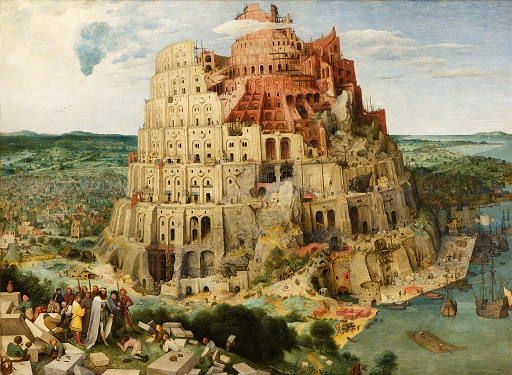
TOWER OF BABEL. Pieter Bruegel the Elder’s painting Tower of Babel is on display at the Kunsthistorisches Museum in Vienna. Ben Witherington III explains that what happened at Pentecost—speaking in tongues—overcame the effect of the Tower of Babel—the confusion of language.
Witherington further explains that what happened at Pentecost is the opposite of what occurred at the Tower of Babel (Genesis 11:1–9). As a result of the Tower of Babel, human language is confused, and a language barrier is created, but at Pentecost, the language barrier is surmounted:
At Pentecost the multiple languages problem and language barrier is not resolved, but the Good News overcomes the problem by being shared in all the various languages of the persons present there. While Pentecost doesn’t reverse the effect of God’s confusing the languages at Babel, it overcomes the problem for the sake of the salvation of the nations.
To see Ben Witherington III’s full analysis of what happened at Pentecost, read his Biblical Views column “Speaking in the Tongues of Men or Angels?” in the July/August 2015 issue of BAR.
BAS Library Members: Read the full Biblical Views column “Speaking in the Tongues of Men or Angels?” by Ben Witherington III in the July/August 2015 issue of Biblical Archaeology Review.
Not a BAS Library or All-Access Member yet? Join today.
This article was first published in Bible History Daily on July 13, 2015.
All-Access members, read more in the BAS Library
Biblical Views: Text Archaeology: The Finding of Lightfoot’s Lost Manuscripts
Biblical Views: Spirited Discourse About God Language in the New Testament
Not a BAS Library or All-Access Member yet? Join today.
Related Posts


Must-Read Free eBooks
Want more Bible history?
Sign up to receive our email newsletter and never miss an update.
Unlock Unlimited Access to the Bible's Past

Unlock Unlimited Access to the Bible's Past
Become an All-Access Member to explore the Bible's rich history. Get Biblical Archaeology Review in print, full online access, and FREE online talks. Plus, enjoy special Travel/Study discounts. Don't miss out—begin your journey today!

Xenoglossy
Is it biblical to speak in tongues today.
John Calvin, I think, is presently in Heaven. However, he did a huge disservice to his followers in several denominations today by maintaining that the miracles of the early Church were to just get the Church started, and that was that. The Modern Church is starving, as a result!
To understand what is being discussed in this article, you must experience the “tongues” firsthand in your own prayer life. I’m a Roman Catholic, yet shortly after being prayed for by my Pentecostal bretheren in 1972, I received the gift of “tongues” or glossolalia, and this gift has somehow stayed with me ever since. I have seen miraculous effect of my unintelligible utterances on two Hindus (who shortly afterward showed up at our Christian prayer meeting!), but most times, the gift seems to be a facilitating prayer-mode for my own private prayer that allows me to praise and worship The Most High, even when I don’t feel like praying – sort of a Psalm 50 response.
Paul of Tarsus advocated that the gift not be used in public community worship 1Cor 14:6-23, but emphasizes verse 18! It is a very, very powerful prayer, as it seems to be the Voice of the Holy Spirit Himself speaking to God the Father. The effects of this type of prayer on my own life are generally immediate and tangible. BTW, I had a rough upbringing, and perhaps I need supernatural miracles every day, just to keep me in the Church!
Finally, the outward manifestation of the falling of the Holy Spirit upon the New Testament early converts is attested to by the Kol Ha Kadosh. See Philip in Samaria Acts 8:14-16, Peter in Cornelius’ house Acts 10:44-49 & 11:15-16, Paul in Ephesus Acts 19:1-7. Note that the effect in Samaria was so powerful, that Shimon the Magician offered Peter money for the ability to cause this effect, and the falling of the Holy Spirit upon the house of Cornelius actually preceded the water baptism! All of this is still very much evident in our modern Christian churches if you seek sufficiently.
There is so much more to say and experience in this gift, but I must necessarily limit my response for this column.
Ben is correct! In the KJV what happened in Acts 2:4 is described as “other tongues” which means just that – other earthly languages….
It’s in 1 Corinthians 12-14 that Paul mentioned praying in an “unknown tongue” (glossolalia), Heavenly language and tongues of angels (1 Corinthians 13:1) that he says that his Spirit prays mysteries to God and Human understanding is unfruitful.
So big difference between “other tongues” & “unknown tongues”
Tongues, Speaking in
A joint statement by the Fountain Trust and the Church of England Evangelical Council admitted: “We are also aware that a similar phenomenon can occur under occult/demonic influence.” (Gospel and Spirit, April 1977, published by the Fountain Trust and the Church of England Evangelical Council, p. 12) The book Religious Movements in Contemporary America (edited by Irving I. Zaretsky and Mark P. Leone, quoting L. P. Gerlach) reports that in Haiti ‘speaking in tongues’ is characteristic of both Pentecostal and Voodoo religions.—(Princeton, N.J.; 1974), p. 693; see also 2 Thessalonians 2:9, 10
Clearly, modern-day speaking in tongues is very different from the gift of holy spirit given to Jesus’ early followers. In fact, there is no reliable record of anyone receiving that same miraculous power since the death of the apostles. This is not surprising to Bible readers. Regarding the miraculous gifts, including that of speaking in tongues, the inspired apostle Paul prophesied: “They will cease.” (1 Corinthians 13:8) How, then, can one discern who has the holy spirit today?
Who Give Evidence of Having Holy Spirit?
Jesus well knew that the gift of tongues would cease relatively soon after the formation of the Christian congregation. Shortly before he died, Jesus mentioned a timeless sign, or mark, that would identify his true followers. “By this all will know that you are my disciples,” he said, “if you have love among yourselves.” (John 13:35) In fact, in the same verse where God’s Word foretold that the miraculous gifts would eventually cease, it says: “Love never fails.”—1 Corinthians 13:8.
http://wol.jw.org/en/wol/d/r1/lp-e/1200275865
What I don’t get about the “speaking in tongues” business is that when it supposedly happens in the bible, the listeners understand what the disciples are saying. When people supposedly “speak in tongues” nowadays, they just spout endless strings of nonsense syllables. The OED defines “Glossolalia” as “The phenomenon of (apparently) speaking in an unknown language, especially in religious worship. It is practiced especially by Pentecostal and charismatic Christians.” The disciples on Pentecost were apparently speaking in multiple known languages. I don’t see the connection.
It’s hard to see how any of this would leave a trace in the archaeological record. Where’s the evidence?
“Are the disciples speaking in human languages, or is this an instance of glossolalia in the Bible?”
Or….could this just be a made up story? I guess these articles are not written from an objective standpoint…
Unless you site a source that is from the first to third century, it is just the writers opinion. Critics of speaking in tongues do not have the gift.. Read 1 Corinthians 12: 4-11 list the gifts that people are given. Two of those gifts listed in verse 10 is different kinds of tongues and another gift listed is interpretation of tongues. 1 Cor 14:2 For he who speaks in a tongue does not speak to men but to God, No one understands him, however in the spirit he speaks mysteries.
1 Cor 13:8 is a contrast between love and the gifts. We know today that knowledge has increased greatly, it has not vanished away and neither has tongues ceased.
I have a friend that was a Missionary in Nevada to the Indians. He started many small churches there. In one service a Spanish speaking fellow came into the service and when the preacher gave the plan of salvation he came forward. The preacher was concerned with getting an interpreter for the Spanish speaking man but he had heard the message in Spanish. Explain that.
(Robert #3 again replies)
Most Christians today obtain an education – that results in a “belief”, tentative as it is.
When the Lord reveals Himself to you – that results in “Faith”. No-one can take that away from you afterwards. Faith is also a supernatural gift.
Experience his Love (also a supernatural gift), which includes tongues as a prayer language. You will then have it.
This is all accessible to you today. Please, please dear Christians – pray for his revelation to you. Use the Name of his Son to ask for it (as He says) and you will receive.
It is true, I have seen demonic tongues firsthand. But we know how the devil counterfeits.