Rahab the Harlot?
The wall of Jericho yields insights into the home of Rahab in the Bible
In the Book of Joshua, Rahab (a heroine nonetheless known as “Rahab the Harlot”) assisted two Israelite spies in escaping out a window and down the city wall of Jericho. Who was Rahab in the Bible? A Biblical prostitute or just an innkeeper? Did she live on the wall of Jericho or within it, in what is known to archaeologists as a casemate wall? Anthony J. Frendo addresses these questions about the life of Rahab in the Bible in the September/October 2013 issue of Biblical Archaeology Review. Whether or not she was a Biblical prostitute, archaeology may at least be able to answer whether Rahab lived on or in the casemate wall of Jericho.
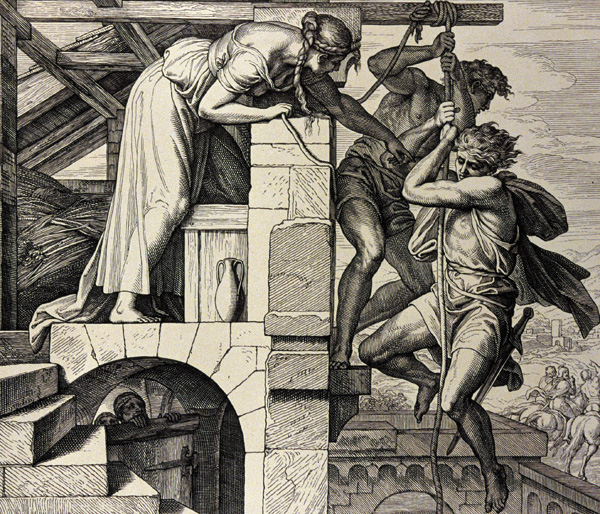
Rahab the harlot? It may be a surprise to some readers, but Biblical prostitutes were commonly mentioned in the text. What was the profession of Rahab in the Bible? Here, she assists Israelite spies down what may be a casemate wall, within which her home may have been located. Engraving by Julius Schnorr von Carolsfeld, Germany, 1860. Image: CCI/The Art Archive at Art Resource, NY.
Rahab helped two Israelites when they came to spy out the land of Jericho. She hid them on her roof when the king came for them. When the coast was clear, Rahab let the spies down by a rope through the window.
So what do we know about Rahab the harlot? Was she a Biblical prostitute? The Biblical text identifies her as a zônāh, a prostitute (Joshua 2:1), but she seems more like a landlady. Indeed, the first-century C.E. historian Josephus reports that she kept an inn. The consonants that comprise the word “prostitute” in Hebrew are znh, which are the same consonants that comprise the Hebrew word for a female who gives food and provisions. The text doesn’t describe Rahab’s profession negatively, as one might expect from a description of Biblical prostitutes. The lifestyle of Rahab in the Bible continues to elude us. Whether we remember her as Rahab the harlot or innkeeper, she was a Biblical heroine.
We may be able to understand the chronology of the story by examining whether Rahab lived on the wall of Jericho or in the city’s casemate. The structure of the city wall varied in different periods in ancient Israel. In the Late Bronze Age, the time in which the story of Rahab in the Bible was set, thick defensive walls were common; people could conceivably have lived on them. During the Iron Age II period (sixth century B.C.E.), when the Book of Joshua was thought to have been edited, Israelite settlements were often surrounded by a casemate wall, which was comprised of two parallel walls with periodic perpendicular walls, forming casemates, or rooms, that people lived within. Analyzing the Hebrew words for “within the wall,” which described the residence of Rahab the harlot, along with the chronology of defensive construction in ancient Israel, Frendo suggests that Rahab lived on the wall. Frendo proposes that an editor changed the Hebrew to reflect that Rahab lived in the wall of Jericho within a casemate wall, rather than on top of a thick defensive wall, to make the text understandable to people in Israel during the late Iron Age.
BAS Library Members: Read the full article “Was Rahab Really a Harlot?” by Anthony J. Frendo as it appears in the September/October 2013 issue of Biblical Archaeology Review.
Not a BAS Library or All-Access Member yet? Join today.
This Bible History Daily feature was originally published on September 23, 2013.
Related reading in Bible History Daily:
All-Access members, read more in the BAS Library:
Forgotten Heroines of the Exodus: The exclusion of women from Moses’ vision
Cult Prostitution in Ancient Israel?
Not a BAS Library or All-Access Member yet? Join today.
Related Posts


Feb 26
Who Was Phoebe?


Must-Read Free eBooks

Want more Bible history?
Sign up to receive our email newsletter and never miss an update.
Unlock Unlimited Access to the Bible's Past

Unlock Unlimited Access to the Bible's Past
Become an All-Access Member to explore the Bible's rich history. Get Biblical Archaeology Review in print, full online access, and FREE online talks. Plus, enjoy special Travel/Study discounts. Don't miss out—begin your journey today!

Why is it so important to us whether Rahab a harlot or inn-keeper or combo of these? Aren’t the important things how she 1-willingly participated in this narrative, furthering God’s plans? and 2- serves as ex for each of us that NO MATTER OUR STATION in life, we can play a crucial and irreplaceable part in God’s plan?
It’s inspiring to know that God can and will use anyone who will surrender and make themselves totally available to God. Despite your past, God can use YOU just as you are. It doesn’t matter how others perceive you.
why don’t you cite the artist? bad form
From the Book of Joshua in Hebrew and the richly detailed video production of La tierra prometida in Spanish and Portuguese, Rahab is depicted as a kind, caring, brave woman, who had to balance daily dangers with faith. She and her family were protected from any destruction during the fall of Jericho. She converted to Judiasim and married Salmon, one of the Hebrew scouts she saved in Jericho, and they became the parents of Boaz, the future husband of Ruth. Rahab is also described as the wife of Joshua. She has been a true hero to the Children of Israel.